Info

Cat trap

Remote control dog trap
The Animais de Rua’s main goal is to increase TNR (Trap-Neuter-Return) activities. Feral animals are, in most cases, unsociable, and therefore cannot be adopted. Since the Animais de Rua Association has a strict no-kill policy, we adamantly oppose our Government’s Animal Control guidelines to capture and destroy them (unless, of course, they suffer from incurable disease and are in appreciable pain).
We believe that the solution for feral packs and colonies that procreate in public locations is having them neutered/spayed. All the animals captured by our Association are neutered/spayed, treated for internal and external parasites as well as any illnesses, and finally marked by cutting off the tip of their left ear – the international mark of a spayed/neutered animal. They are then released back to their territory and fed by the Association and individuals responsible for their protection. Once spayed/neutered, these animals will no longer breed and the feral population will decrease dramatically.
Studies show that capturing and killing cat colonies is not an efficient population control method, since it only leaves the recently empty territory (a phenomenon known as the “vacuum effect”) available to other fertile, hungry and uncontrolled cats from neighbouring colonies.
A neutered cat colony is a healthy colony. The dishes they are fed in are kept clean and the felines are quiet (since there are no mating cries and no need to fight for females or food) and have an important role in rodent population control.
With dog packs the situation is very similar – once spayed/neutered and given enough food, the dogs tend to calm down and stop wandering in search of food and mating partners. The aggressive behaviours motivated by food and female search also cease to exist.
The captured tame or docile animals are sent to foster care whenever possible or released back to their familiar territory while we search for possible permanent homes.
Capturing
Feral cats and dogs are captured in special cruelty-free traps and the tame ones are captured by hand. They are then taken to a veterinary clinic, where they spend the night without food or water to await for surgery the very next day.

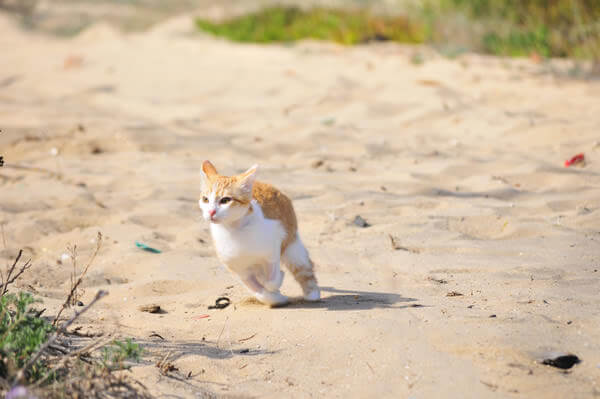
Sterilized Cat with cut in the left ear
Click in the photo to see detail of the cut

Sterilized dog with cut in the left ear
Click in the photo to see detail of the cut

Sterilized dog with cut in the left ear
Click in the photo to see detail of the cut
Post-Ops
Males can be released the day after surgery – they are given a 48h-effect antibiotic during the procedure. Females have to take antibiotics for 5 extra days, so they are released a little later. They are kept in carriers lined with newspaper and the medicine is mixed with canned food every day – more food is only given after the available one is eaten. The newspaper is changed daily to keep the carriers clean and fresh water is always available. When tame, the cats can be kept in a room with a litter box and a comfortable place to sleep in. Female cats and dogs can then be released without needing extra veterinary attention – one has to ask the vets to do self-absorbing stitches and not resort to collars.
Some care is needed when changing the cat litter to prevent the feline from escaping. The carrier door should be opened with care and as little as possible, the old newspaper taken out and the new one placed on top of the cat – she will move to get above the newspaper. Cats usually don’t try to escape, they just keep themselves to the back of the carrier, but it is best to attempt this in a confined room, so if she escapes, she is still safe from harm and is easier to re-capture.
Post-operatory procedures are easy to perform and don’t take much of the caretaker’s time or space.
Note: The Animais de Rua Association supports individuals or groups of people that are willing to spay/neuter cat colonies by giving on-site tutorials and, if necessary, by lending traps (cash deposit needed).